Munich is the capital of Bavaria and the third-largest city in Germany. For visitors, the city offers an impressive variety of attractions. It is no coincidence that Munich is one of the most visited destinations in Germany, second only to Berlin. Many tourists come for the famous beer culture, the Oktoberfest, the Hofbräuhaus or traditional Weißwürste. Others are drawn by world-renowned museums such as the Deutsches Museum, the three Pinakotheken, the Haus der Kunst or the Glyptothek.
Architecture enthusiasts admire the historic old town with the Frauenkirche, the Neo-Gothic Town Hall at Marienplatz and the Residenz, the former royal palace of the Bavarian rulers. Sports fans visit the Olympic Park, built for the 1972 Summer Olympics, or the modern Allianz Arena football stadium. Many visitors also enjoy the relaxed atmosphere of Munich, sometimes described as almost Mediterranean, especially in summer. The district of Schwabing with Leopoldstraße and one of Germany’s largest universities adds a lively, youthful touch to the city.
The main focus of this online travel guide is the many sights of Munich and practical information for visitors.
Read also our Berlin travel guide on the internet. Also we have a Vienna Online-Guide.
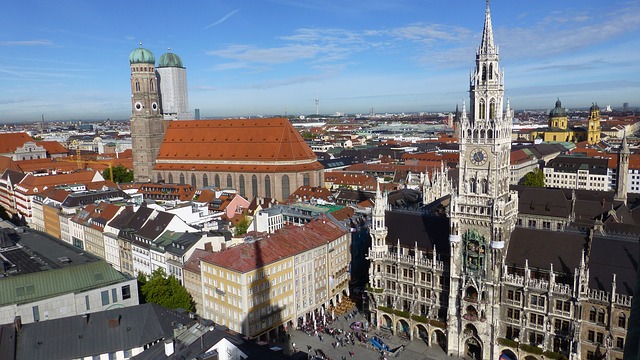 Munich centre: In the foreground the city hall and Marienplatz, in the back the Frauenkirche
Munich is a comparatively young city with a history of less than 900 years. It is known for its high quality of life. Low unemployment, economic strength and well-maintained public spaces are often mentioned as characteristics of the Bavarian capital. The city has many large green areas, above all the Englischer Garten, one of the biggest inner-city parks in Europe. The nearby Alps, numerous lakes and the short distance to Italy further increase Munich’s appeal.
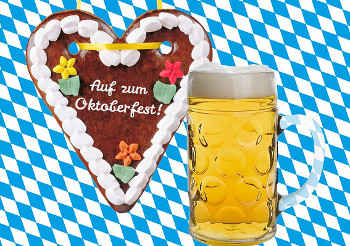 In this Munich travel guide you will also find information about the Oktoberfest
Over the years, many clichés have developed about Munich. It is sometimes called the “secret capital of Germany”, “the largest village in the world”, “the cosmopolitan city with a heart”, the “beer capital of the world” or even “the northernmost city on the Mediterranean”.
Surveys show that a significant share of Germans and Austrians would prefer to live in Munich if given the choice. However, high living costs – especially very high rents and property prices – make this difficult for many people. Despite its popularity and economic strength, Munich has around 1.5 million inhabitants. The population continues to grow, but rising housing costs are increasingly discussed as a social challenge.

For tourists, many of Munich’s main sights are located in the compact city centre. From the central transport hub at Marienplatz (U-Bahn and S-Bahn), you can reach numerous attractions on foot within a short time. Other highlights described in this travel guide are easily accessible by public transport. There is a lot to see in Munich. Visitors should plan at least several days for sightseeing. A longer stay of one or two weeks allows a more relaxed exploration, including museums, parks and day trips to the surrounding region.Okt
oberfest
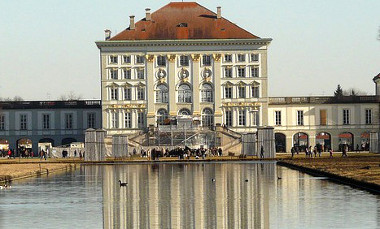 Nymphenburg Palace, one of the great sights of Munich
Munich has an excellent public transport system. The underground (U-Bahn) network includes around 100 stations, while the S-Bahn suburban railway connects the city with the surrounding region through about 200 stations. Districts not directly served by U-Bahn or S-Bahn are covered by trams and buses. In Munich, the tram is officially called “Tram”, even on public notices.
Public transport is continuously being expanded. Major infrastructure projects include the construction of a second S-Bahn trunk line through the city centre and further extensions of the underground network. These developments aim to improve capacity and reliability in one of Germany’s busiest metropolitan areas.
In recent decades, Munich has become more international. Only about one third of residents were born in the city. While traditional Bavarian culture is still visible in festivals, beer gardens and cuisine, Munich today is also a modern, cosmopolitan metropolis. Even so, the city south of the so-called “Weißwurst equator” remains closely associated with Bavarian identity.
In this travel guide you will find detailed information about Munich’s most important sights, practical travel tips and recommendations for your stay.
Prague Guide Venice Guide Dresden Guide Tickets Parliament Hungary