 Veröffentlicht von
 The Feldherrnhalle in Munich is one of the most historically significant monuments in the Bavarian capital. Located at Odeonsplatz, at the southern edge of the historic city center, the Feldherrnhalle is both an architectural landmark and a place deeply connected to German and Bavarian history.
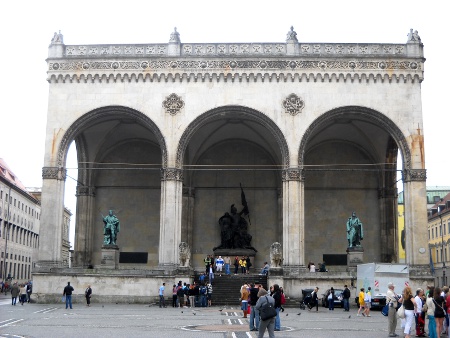
At first glance, it looks like an elegant open loggia inspired by Italian Renaissance architecture. But behind its beautiful arcades lies a complex story involving the Bavarian army, national identity and the rise of National Socialism in the 20th century.
Munich Historical Walking Tours
Guided tours around Odeonsplatz and the old town explain the history of the Feldherrnhalle and the 1923 Beer Hall Putsch in context.
Where is the Feldherrnhalle?
The Feldherrnhalle stands prominently on the south side of Odeonsplatz, one of Munich’s most impressive squares. It forms a visual connection between:
- The Munich Residence (east)
- The Theatinerkirche (west)
- The entrance to the pedestrian zone toward Marienplatz
If you explore Munich’s historic center on foot, you will almost certainly pass the Feldherrnhalle.
Architecture and Design
The Feldherrnhalle was built between 1841 and 1844 under King Ludwig I of Bavaria. The architect Friedrich von Gärtner designed it in the style of the famous Loggia dei Lanzi in Florence.
Architectural features include:
- Three large open arches
- Massive stone columns
- High platform with steps
- Symmetrical Renaissance proportions
The monument was intended to honor the Bavarian army and its military leaders. It reflects the 19th-century European tradition of celebrating military power and national pride through monumental architecture.
The Statues
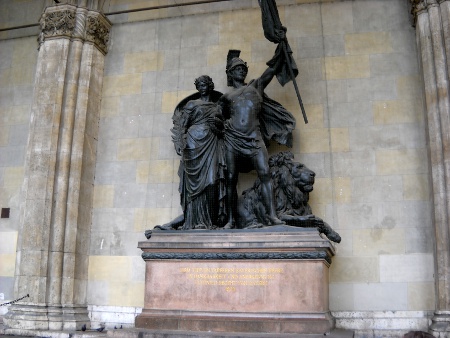
Inside the Feldherrnhalle are statues of two important Bavarian military figures:
- Count Johann Tilly (commander during the Thirty Years’ War)
- Prince Karl Philipp von Wrede (Napoleonic era)
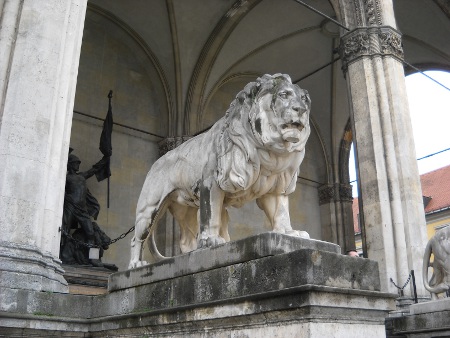
In front of the monument, two large lion sculptures guard the staircase. These lions were added later and are among the most photographed elements of the structure.
The Beer Hall Putsch (1923)
The Feldherrnhalle became internationally known because of events on November 9, 1923. On that day, Adolf Hitler and members of the National Socialist movement attempted a coup in Munich – the so-called Beer Hall Putsch.
The march ended at the Feldherrnhalle, where police forces confronted the putschists. Shots were fired, and several people died. The coup failed, and Hitler was arrested shortly afterward.
Later, during the Nazi regime, the Feldherrnhalle became a symbolic site for propaganda. A memorial was installed, and passersby were required to perform the Hitler salute when walking past. After World War II, these Nazi elements were removed.
Today, the site is approached in a historically critical way. Small plaques and contextual information remind visitors of the darker chapters of its history.
Why the Feldherrnhalle Still Matters
The Feldherrnhalle is not just a monument to 19th-century military history. It is also a physical reminder of how public spaces can change meaning over time.
For visitors, the monument offers:
- Architectural beauty
- Historical depth
- A central meeting point
- A key location in German political history
Understanding the Feldherrnhalle helps visitors understand Munich’s role in early 20th-century German history.
What to Do When Visiting
- Walk up the steps and look at the statues
- Photograph the lion sculptures
- Observe Odeonsplatz from the elevated platform
- Combine the visit with the Theatinerkirche and Residence
Because the Feldherrnhalle is open and free, you can visit at any time of day.
Best Time to Visit
Morning: Fewer crowds and better light for photography.
Afternoon: Lively square atmosphere.
Evening: The surrounding buildings are illuminated, creating an impressive setting.
How Long Should You Stay?
- 10–15 minutes: Quick architectural stop
- 30 minutes: With historical context and photos
- 1 hour: Combine with Odeonsplatz and Theatinerkirche
Tip: Great city tour through Munich
Many important sights in Munich are not far from each other in the center. There is a very good walking tour of the city every day, ideal for a first overview of the attractions in the city center. On this tour you can see, among other things, Marienplatz with the town hall, the famous Frauenkirche, the Hofbräuhaus and the famous Viktualienmarkt. Duration of the tour approximately 1.5 hours, 1-2 times a day, language German. Almost all participants rate this city tour very positively. Can be booked online, not expensive. More on this at the following link:
>>>>> Information, prices and booking on the internet city tour of Munich city center at Getyourguide.de
How to Get There
The nearest U-Bahn station is Odeonsplatz (U3, U4, U5, U6). From there, the Feldherrnhalle is directly visible.
Nearby Attractions
Hotels near Odeonsplatz
Staying near Odeonsplatz means you are within walking distance of the Feldherrnhalle, Residence, Hofgarten and Marienplatz.
Pros and Cons
Pros
- Central location
- Free access
- Architectural highlight
- Important historical site
Cons
- No interior museum
- Often crowded during peak tourist hours
Is the Feldherrnhalle Worth Visiting?
Yes. Even though the visit itself is short, the Feldherrnhalle is one of Munich’s key historic monuments. It combines impressive architecture with complex political history. Because it stands directly on Odeonsplatz, it is easy to include in any old-town walking route.
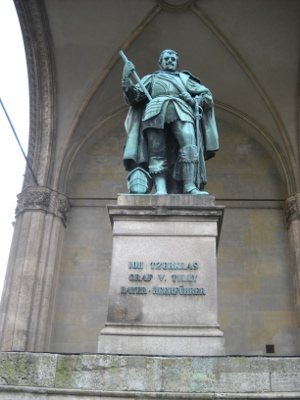 Tilly monument in front of the Feldherrnhalle
Beer tour Munich: Great city tour with a guide through Munich on the topic of beer, beer halls, breweries, wheat beer including a stay in beer halls and 2 free beers. In the evening, duration 3.5 hours. Be sure to book online, very popular: More information and booking