 Veröffentlicht von
 Munich has one of the most efficient and reliable public transport systems in Europe. Whether you are visiting the Marienplatz, heading to the Olympic Park, or traveling from Munich Airport into the city, the MVV network makes getting around easy.
This guide explains everything you need to know about public transport in Munich: U-Bahn, S-Bahn, trams, buses, ticket types, zones and practical travel tips.
Explore Munich Easily
Many city tours include transport options or start near major public transport hubs.
Overview of Munich’s Transport System
Munich’s public transport system is coordinated by the MVV (Münchner Verkehrs- und Tarifverbund). It integrates:
- U-Bahn (subway)
- S-Bahn (suburban trains)
- Trams
- Buses
All modes use the same ticket system.
U-Bahn (Subway)
The U-Bahn is the fastest way to travel within the city. It consists of several lines (U1 to U8) connecting central districts and outer neighborhoods.
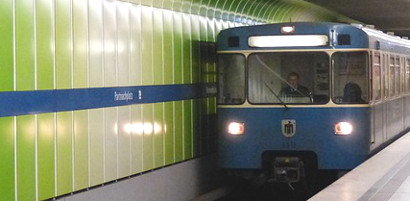 The older model of the subway. In the meantime , a completely new subway model called C2
Main stations include:
- Marienplatz
- Sendlinger Tor
- Odeonsplatz
- Hauptbahnhof (Central Station)
Trains usually run every 5–10 minutes during the day.
S-Bahn (Suburban Railway)
The S-Bahn connects Munich with surrounding towns and the airport. The main trunk line runs underground through the city center.
Important S-Bahn routes:
- S1 & S8 – Munich Airport
- S6 – Starnberg
- S7 – Wolfratshausen
If you arrive at Munich Airport, the S-Bahn is the most convenient way to reach the city center.
Trams
Munich’s tram network covers areas not directly served by the U-Bahn. Trams are ideal for short inner-city journeys and offer scenic views at street level.
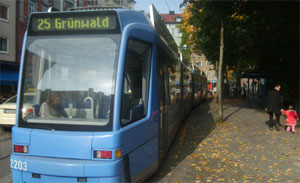 In Munich the tram is officially called Tram
Buses
Buses complement the network and operate in neighborhoods without rail connections. Night buses run after midnight when regular services stop.
Ticket Zones
Munich uses a zone system. The city center is Zone M (formerly inner zone). Surrounding districts and the airport are located in additional zones.
Most tourists staying within central Munich only need a Zone M ticket.
Types of Tickets
- Single ticket – one trip
- Stripe ticket – flexible multi-ride option
- Day ticket (Tageskarte) – unlimited travel for one day
- Group day ticket – for up to 5 people
- Airport day ticket – includes extended zones
For most visitors, a day ticket is the easiest and most economical option.
How to Buy Tickets
- Ticket machines at stations
- MVV mobile app
- Online purchase
Tickets must be validated before boarding (except digital tickets).
Travel from Munich Airport
The airport is connected via S1 and S8 lines. Travel time to the city center is about 40–45 minutes.
You need a ticket covering the airport zone.
Night Transport
On weekends, U-Bahn and S-Bahn services run longer hours. Night buses operate daily after midnight.
Accessibility
Most U-Bahn and S-Bahn stations have elevators and step-free access. Trams and buses are generally low-floor.
Practical Tips
- Buy a day ticket if you plan multiple trips
- Download the MVV app for route planning
- Keep your ticket until the end of your journey
- Check zone coverage before buying tickets
Pros and Cons
Pros
- Reliable and punctual
- Comprehensive network
- Safe and clean
- Clear signage
Cons
- Ticket system can be confusing for first-time visitors
- Airport tickets are relatively expensive
- Occasional construction work
Is Public Transport in Munich Good?
Yes. Munich’s public transport system is efficient, safe and easy to use. Most visitors can explore the entire city without renting a car.
By bicycle in Munich
Munich is one of Germany’s most bicycle-friendly cities. There is an extensive network of marked bike lanes, and in many streets the sidewalks are divided: the section closer to the road is reserved for cyclists. This makes getting around by bike relatively safe and convenient, even in busier areas.
Cycling is also a great way to explore Munich’s large green spaces. Parks such as the English Garden and the riverside paths along the Isar are ideal for relaxed bike rides. The flat terrain in most parts of the city makes cycling easy, even for visitors who are not used to riding regularly.
Bicycles can be rented at several locations throughout the city, including at Munich’s main train station. One well-known provider is Call a Bike, a subsidiary of Deutsche Bahn. Rental prices vary depending on duration and tariff. Day passes are available, and there are also per-minute rates for short trips. Rail card holders and registered members often receive discounted prices. In addition, bikes can usually be picked up and returned at different stations within the city, offering flexibility for short urban trips.
By car in Munich
Driving in Munich can be convenient for day trips and exploring the wider region, but the city center has restrictions and heavy traffic during peak times.
️ Getting Into Munich
-
Munich is well-connected to the German autobahn network.
-
From the north via A9 (from Nuremberg/Berlin)
-
From the east/west via A94 and A8 (from Salzburg or Stuttgart)
-
From the south via A95 (toward Garmisch-Partenkirchen)
-
Traffic into the city is usually slower during weekday rush hours (approx. 07:00–09:00 and 16:00–18:30).
️ Parking in Munich
Munich has both on-street parking and parking garages:
On-street zones
-
Zones marked with blue or orange signs mean paid parking.
-
Use pay machines or apps like EasyPark or ParkNow.
-
There are resident-only areas — watch signs carefully.
Parking garages
-
Central garages are convenient but can be expensive.
-
Recommended near major sights:
-
Near Marienplatz
-
Around Hauptbahnhof (central station)
-
Close to museums and Altstadt
-
Tip: Park once and explore on foot or by public transport — Munich’s city center is compact.
City Driving Rules
-
Speed limits:
-
Urban roads: 50 km/h
-
Residential areas: 30 km/h often enforced
-
-
Low Emission Zone (Umweltzone):
-
Munich has a low-emission zone in the inner city.
-
Your car needs a green emissions sticker (Feinstaubplakette) to enter.
-
-
Seat belts and mobile phone rules are strict — fines apply.
⛽ Fuel & Services
-
Gas stations are plentiful outside the core centre and along major roads.
-
Prices may be higher near the city center.
-
Most stations take credit cards; Apple/Google Pay is increasingly accepted.
Best Uses for a Car in Munich
✔ Day trips:
-
Neuschwanstein Castle, Tegernsee, Chiemsee, Zugspitze
✔ Airport transfer (via A92)
✔ Visiting attractions outside the core city
When a Car Is NOT Ideal
-
Exploring Altstadt (Old Town)
-
Rush hour traffic
-
Parking scarcity in central zones
In many cases, Munich’s efficient public transport (U-Bahn, S-Bahn, trams, buses) is faster and cheaper than driving central.
Our recommendation: Best city tours in Munich
3 bus-lines, all with one ticket: Be sure to buy tickets for CitySightseeing Munich cheaply online using this link
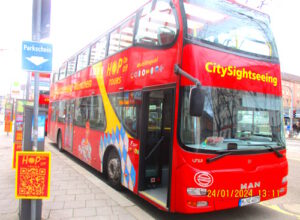
You can get out on the way and continue on the next bus (hop-on hop-off)
Bookable online with a discount using using this link
All 3 lines depart directly opposite Munich main station