 Veröffentlicht von
 The Hofgarten in Munich is one of the most elegant and centrally located parks in the Bavarian capital. Situated between the Munich Residence and the English Garden, the Hofgarten forms a green oasis right in the historic city center.

Unlike the vast English Garden, the Hofgarten is compact, symmetrical and architecturally refined. It combines Renaissance design, baroque elements and Italian-style arcades. For visitors exploring Munich’s old town, the Hofgarten is one of the easiest and most pleasant places to take a break.
Munich Walking Tours
Guided city tours often include Odeonsplatz, the Residence and a short stop in the Hofgarten. If you want context (history + architecture) while walking, a tour can be worth it.
Quick Overview: What to Expect
The Hofgarten is not a “big attraction” in the classic sense. It is a historic court garden in the middle of Munich’s old town area. You come here for a short break, for atmosphere, for photos and for an easy walk between major sights. It is free, always accessible, and you can visit in any season.
- Best for: a calm break, architecture, short walks, photos
- Time needed: 15 minutes to 1 hour
- Cost: free
- Location: between the Residence, Odeonsplatz and the English Garden
Where is the Hofgarten?
The Hofgarten is located directly behind the Munich Residence in the Old Town. It connects several important landmarks:
- Odeonsplatz (south)
- The Bavarian State Chancellery (east)
- The English Garden (north)
- The Munich Residence (west)
Because of this central position, you will likely pass through the Hofgarten while exploring Munich on foot. Many visitors enter from Odeonsplatz, cross the garden, and then continue either to the Residence courtyards or north toward the English Garden.
Why the Hofgarten is Special
Munich has many green spaces, but the Hofgarten feels different. It is not a “nature park” like the English Garden. It is an urban, designed garden with a very clear concept: symmetry, perspective and controlled beauty. The geometry of the paths creates a calm rhythm, and the arcades add an Italian atmosphere that feels surprisingly Mediterranean on a sunny day.
In practical terms, that means: even if you are not a garden lover, the Hofgarten works well as a “breathing space” during sightseeing. You get a short change of pace without leaving the center.
History of the Hofgarten
The Hofgarten was created in the early 17th century under Duke Maximilian I of Bavaria. It was designed as a Renaissance court garden inspired by Italian models. At the time, Munich was developing into a major political center in the region, and a representative garden was part of the court’s image.
Originally, the garden was reserved for the royal court. Over time, it became accessible to the public and is now one of Munich’s most beloved green spaces. The transition from exclusive court garden to open public space is one reason why the Hofgarten still matters today: it feels historic, but it is used in a very everyday way.
During World War II, parts of the Hofgarten were damaged. After reconstruction, the garden regained its historical structure while integrating modern elements like the nearby State Chancellery building. This creates an interesting mix: Renaissance garden design next to post-war and contemporary architecture.
Layout and Architecture
The Hofgarten is known for its symmetrical layout. Gravel paths divide the square garden into geometrically arranged sections with lawns and flower beds. This symmetry is not only pretty; it is part of the “court garden logic”: you feel order, control and perspective. If you like photography, the center lines are perfect for clean, balanced shots.
Dianatempel (Temple of Diana)
The most famous structure in the center is the Dianatempel, a circular pavilion built in 1615. It features arcades and a dome with a statue symbolizing Bavaria. The pavilion is a natural focal point: most paths lead toward it, and it anchors the entire garden visually.
The Dianatempel is also a social place. It is a popular meeting point and often used by street musicians. Acoustic conditions under the dome are surprisingly good, which is why musicians return again and again. If you pass through and hear live music, it is one of those “small Munich moments” that feels authentic.
Arcades
Along the western and northern sides of the garden, elegant arcades create a Mediterranean atmosphere. These covered walkways are ideal for shade in summer or protection from light rain.
The ceiling frescoes in the arcades were restored after the war and reflect historical themes. Even if you just walk through quickly, it is worth slowing down for a minute and looking up. The arcades are also a great place for calm photos with softer light.
The Bavarian State Chancellery (East Side)
On the eastern side of the Hofgarten you see the Bavarian State Chancellery. This building is a good example of how Munich combines historical and modern layers. The contrast between the structured garden and the state buildings makes the Hofgarten feel “very Munich”: traditional, but not frozen in time.
For visitors, the important point is simple: this side is usually less crowded. If Odeonsplatz feels busy, walk deeper into the garden and sit on the quieter eastern benches.
Atmosphere and Daily Life
The Hofgarten feels calm and refined. Office workers eat lunch on benches, students relax on the grass and tourists take photos of the Dianatempel. Because the garden is central, the people mix is interesting: locals treat it as part of their daily routine, while visitors experience it as a sightseeing stop.
Compared to the English Garden, the Hofgarten is more structured and less wild. It is ideal for a short break between sightseeing stops. In summer it can be lively, but it rarely feels chaotic. In winter it can be almost silent, which gives it a completely different character.
Best Things to Do at the Hofgarten
- Relax on a bench under the arcades
- Listen to musicians inside the Dianatempel
- Take photos of the symmetrical garden layout
- Walk from Odeonsplatz to the English Garden
- Visit the Munich Residence next door
- Beer tour Munich: Great city tour with a guide through Munich on the topic of beer, beer halls, breweries, wheat beer including a stay in beer halls and 2 free beers. In the evening, duration 3.5 hours. Be sure to book online, very popular: More information and booking
Recommended Mini-Itineraries
15-Minute Visit (Quick Stop)
Enter from Odeonsplatz, walk directly to the Dianatempel, take a few photos, then exit toward the Residence. This works well if you are short on time or want a short “green pause” between sights.
30–45 Minutes (Best for Most Visitors)
Walk slowly through the central axes, spend a few minutes in the arcades, then sit down for a short break. If musicians are playing at the Dianatempel, stay a little longer. Finish by walking north toward the English Garden for a longer stroll.
1–2 Hours (Hofgarten + Residence Combo)
Start in the Hofgarten, then visit the Residence (or at least the courtyards). End your time around Odeonsplatz. This is a classic “historic center” block and very efficient on foot.
Best Time to Visit
Spring: Flower beds begin to bloom and the garden looks fresh. The light is soft, and it is not too crowded.
Summer: Lively atmosphere with musicians and visitors. The arcades offer shade, which makes the garden pleasant even on warmer days.
Autumn: Warm light and fewer crowds. Excellent for photography and relaxed walks.
Winter: Quiet and peaceful, sometimes covered in snow. If you like calm city walks, winter can be surprisingly beautiful.
If you want the Hofgarten with fewer people, the best times are early morning or late afternoon. Midday tends to be busiest, especially in summer.
How Long Should You Stay?
- 15–20 minutes: Quick photo stop
- 30–45 minutes: Relaxing break
- 1 hour: Hofgarten as part of a larger old-town walk
- 1–2 hours: Combine with the Residence courtyards and Odeonsplatz
Photography Tips (Practical and Simple)
- Symmetry shots: Stand on the main axis and aim straight at the Dianatempel for clean geometry.
- Arcades: Use the covered walkways for soft light and strong lines.
- Golden hour: Late afternoon light gives the garden a warm tone and reduces harsh shadows.
- People for scale: A person in the frame can help show the proportions of the Dianatempel and the garden layout.
Schlemmer-Tour Viktualienmarkt Munich
A very popular guided tour in Munich is the gourmet tour over the famous Viktualienmarkt in the city centre. Duration of the market tour about 2 hours, you can try many things for free: Sausage, cheese, fruits and many Bavarian specialities. Well done, entertaining and informative. Our recommendation.
>>>>> More Information and Booking
How to Get There
The nearest U-Bahn station is Odeonsplatz (U3, U4, U5, U6). From there, it is a short walk to the Hofgarten entrance.
Nearby Sights You Can Combine Easily
Because the Hofgarten sits right in the middle of Munich’s historic core, it is perfect as a connecting stop. These sights are nearby and easy to combine on foot:
- Munich Residence (directly next door)
- Odeonsplatz (main square at the south entrance)
- English Garden (easy walk north)
- Marienplatz (about 10–15 minutes on foot)
- Frauenkirche (easy old-town walk)
If you want a museum stop near the center, consider the Kunstareal area as well (Pinakothek museums). It is not directly next door, but still walkable.
Hotels near Hofgarten
If you stay near the Hofgarten, you are in one of Munich’s most walkable areas: old town, museums, the Residence and the English Garden are all close.
Food and Drink Nearby
The Hofgarten itself is mostly about the garden atmosphere, not about cafés inside. But because you are in the center, you have many options within a short walk. Odeonsplatz and the Residence area have cafés and restaurants, and the old town is full of choices.
If you want the classic Munich combination of “walk + beer garden,” you can continue north into the English Garden. That is where the city changes from historic to relaxed very quickly.
Visitor Tips (Things People Often Miss)
- Use the Hofgarten as a shortcut: It is one of the nicest walking connections between Odeonsplatz, the Residence and the English Garden.
- Take one minute in the arcades: Look up at the ceiling details and frescoes.
- Don’t rush the Dianatempel: If music is playing, stand under the dome for a minute and enjoy the acoustics.
- Rain strategy: The arcades are perfect on a rainy day.
- Winter strategy: The garden can be very quiet and photogenic when lightly covered in snow.
Pros and Cons
Pros
- Central location
- Historic Renaissance design
- Free entry
- Beautiful architecture
- Perfect break spot during old-town sightseeing
Cons
- Relatively small
- Can be busy in peak summer (especially around the Dianatempel)
- Not a “full-day attraction” by itself
Is the Hofgarten Worth Visiting?
Yes. The Hofgarten is one of the easiest “high quality” stops in Munich: free, central, elegant and atmospheric. It is not something you plan an entire day around, but it makes your day in Munich better because it adds calm and beauty between major sights. If you are walking from Odeonsplatz toward the English Garden, there is no reason to skip it.
FAQ – Hofgarten Munich
Is the Hofgarten free to enter?
Yes. The Hofgarten is a public garden and can be visited without an entrance fee.
Is the Hofgarten open at night?
In general, it is accessible like a city park. Lighting exists around the area, but late-night visits are more about a quick walk than sightseeing.
Is the Hofgarten good for families?
Yes. It is flat, compact and easy to navigate with children. It is also a good “calm stop” between more intense sightseeing.
Can you walk from the Hofgarten to the English Garden?
Yes. The Hofgarten connects directly north toward the English Garden, making it an easy combined walk.
What is the Dianatempel?
The Dianatempel is the circular pavilion in the center of the Hofgarten. It is one of the most photographed spots and often hosts street musicians.
Bavarian State Chancellery
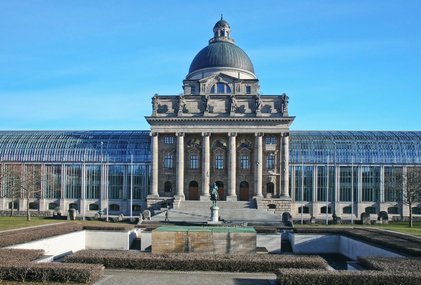 The mixture of old and new architecture in the Bavarian State Chancellery at the Munich Hofgarten (Photo: © C. Schiller – Fotolia.com)
The Bavarian State Chancellery is the highest authority in Bavaria and supports the government and the Minister President. The building was partly newly built in the 80s and 90s (a lot of glass), but partly it was also derived from the old army museum (like the dome in the middle). The architecture of the building is controversial. Some people like the mixture of old and new elements, others do not like this unusual mix at all.
Our recommendation: Best city tours in Munich
3 bus-lines, all with one ticket: Be sure to buy tickets for CitySightseeing Munich cheaply online using this link
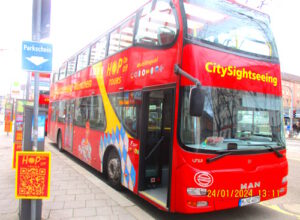
You can get out on the way and continue on the next bus (hop-on hop-off)
Bookable online with a discount using using this link
All 3 lines depart directly opposite Munich main station
Great bike city tour through Munich: The city center of Munich is quite large. It’s not easy to see everything on foot in one day. A bike tour is ideal. On this tour (3 to 3.5 hours) the bike comes from the city tour provider. Well done tour through Munich with sights in the center, English Garden etc.: More information and booking
