 Veröffentlicht von
 Nuremberg, with its largely preserved medieval Old Town, the imposing Nuremberg Castle and the extensive Nuremberg City Walls, is considered one of the most interesting historic cities in Germany. The compact Altstadt, surrounded by massive fortifications, gives visitors a clear impression of how an important imperial city once looked. Towers, gates and narrow streets create an authentic atmosphere that sets Nuremberg apart from many other large German cities.
With more than 500,000 inhabitants, Nuremberg is the second largest city in Bavaria after Munich and the economic and cultural center of Franconia (Franken). Despite its size, the historic center remains manageable and easy to explore on foot. Major sights such as the castle, the main market square and the large Gothic churches are all within walking distance.
Historically, Nuremberg played a key role in the Holy Roman Empire. Emperors stayed at the castle, important imperial assemblies were held here, and the city developed into a center of trade, craftsmanship and art. The legacy of this period is still visible today in the architecture and museums of the Old Town.
For visitors, Nuremberg offers a balanced mix of history, culture and urban life. Medieval buildings stand next to carefully reconstructed post-war structures, traditional Franconian restaurants are found beside modern shops, and museums cover topics from medieval art to 20th-century history. This combination makes the city an attractive destination for both short city breaks and longer stays in northern Bavaria.
Old town and sights
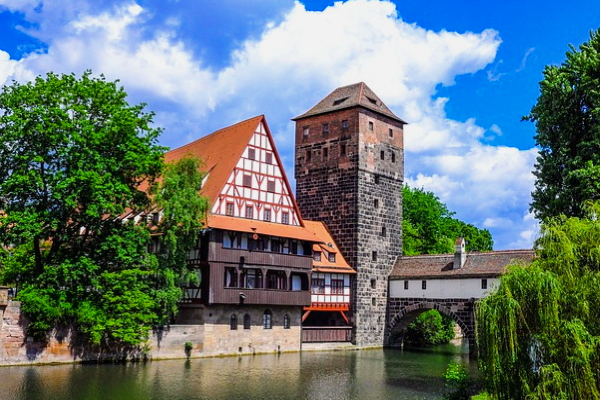
The Old Town of Nuremberg is the historic heart of the city. Almost completely surrounded by a medieval city wall, it combines Gothic churches, half-timbered houses, market squares and narrow streets. Despite heavy destruction in World War II, many buildings were carefully reconstructed. Today, the Altstadt is compact, walkable and ideal for exploring on foot.
Below are the most important sights within the Old Town.
Nuremberg Castle (Kaiserburg)
The Imperial Castle dominates the skyline. It was one of the most important imperial palaces of the Holy Roman Empire. From the Sinwell Tower you get one of the best views over the Old Town rooftops. The castle complex includes courtyards, exhibition rooms and the Deep Well.
Hauptmarkt Nuremberg
The central square of the Old Town. It hosts the weekly market and the famous Christmas Market (Christkindlesmarkt) in December. The square is lively but not overly large, making it easy to explore.
Nearby stands the famous:
Schöner Brunnen
A 14th-century Gothic fountain decorated with colorful figures. Visitors traditionally turn the small golden ring for good luck.
Frauenkirche Nürnberg
Located directly at Hauptmarkt. The Gothic church was built in the 14th century. At noon, you can watch the “Männleinlaufen” mechanical clock show.
St. Lorenz Church
One of the two major churches of the Old Town. It is known for its large rose window and impressive interior. The church stands in the southern part of the Old Town, near the shopping streets.
St. Sebaldus Church
The oldest parish church in Nuremberg, located closer to the castle. Inside you find the tomb of St. Sebaldus, the city’s patron saint.
Albrecht-Dürer-Haus
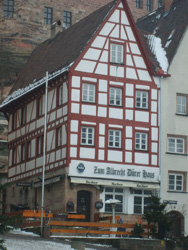
A well-preserved half-timbered house near the castle. The famous Renaissance artist Albrecht Dürer lived and worked here. Today it is a museum about his life and art.
Weißgerbergasse
The most picturesque street in the Old Town. Colorful half-timbered houses line the narrow lane. It is one of the few streets that survived the war largely intact.
Handwerkerhof Nürnberg
Located near the main station and just inside the old city wall. This small artisan courtyard offers traditional craft shops and Franconian food in a medieval-style setting.
Nuremberg City Walls
Large parts of the medieval fortifications are still preserved. You can walk along sections of the wall and see historic towers and gates such as Frauentor and Tiergärtnertor.
Walking Through the Old Town
The entire Old Town can be explored in one day. Distances are short, and most highlights are within a 15–20 minute walk from each other. The atmosphere is lively but manageable compared to cities like Munich or Berlin.
Food in Nuremberg
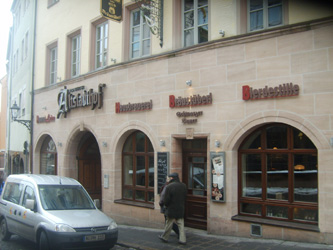
For a break or lunch we recommend the Braustüberl of the famous Nuremberg brewery Altstadthof not far from the castle (picture above left). Here the best beer in Bavaria should be poured out after my many Franconians. Also the good plain food is excellent.
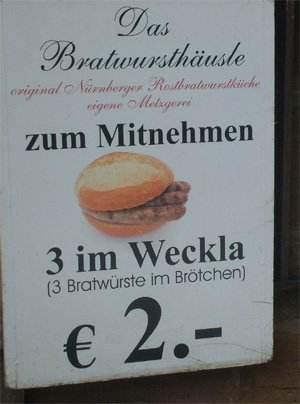
You should definitely try the Nürnberger Bratwurst sausages, which are known throughout Germany. These taste much better in their home town than elsewhere. At the many street stalls, three bratwursts in a roll („3 in the Weckla“) usually cost only two euros. The classic is the small restaurant „Bratwursthäusle“ directly in the centre of the old town. Here the bratwurst sausages taste great and are prepared on an open wooden grill (only with beech wood) just like in the old days.
How to get to Nuremberg: Nuremberg is about 160 kilometres away from Munich. From Munich it is best to take a day trip to Nuremberg by train. We recommend the cheap Bayern-Ticket for 25 Euro for 1 person or 6 Euro per person more (31€, 37 € etc. up to 5 persons (In 2017). However, this is only valid on regional trains and only from 9 am on weekdays. The journey time with such a train is just under two hours, be careful: some trains take considerably longer. With Berlin, Hamburg and Munich, Nuremberg is the fourth city in Germany with a real underground train system. The public transport in Nuremberg is excellent. The subway also runs to the neighboring city of Fürth. Those who travel with the Bayern-Ticket can use public transport in Nuremberg free of charge.
 The castle is the biggest sight in Nuremberg
Top 10 sights in Nuremberg
1. Nuremberg Castle (Kaiserburg)
The landmark of the city. The medieval Imperial Castle rises above the Old Town and offers fantastic panoramic views. Inside you can visit the Imperial Palace, the Deep Well and the Sinwell Tower. Plan around 1.5–2 hours.
2. St. Lorenz Church
A magnificent Gothic church in the heart of the Old Town. Highlights include the large rose window and the famous “Angelic Salutation” sculpture by Veit Stoss.
3. Hauptmarkt & Schöner Brunnen
The central square of Nuremberg. The Beautiful Fountain (Schöner Brunnen) is one of the city’s most famous landmarks. In December, this is where the world-famous Christkindlesmarkt takes place.
4. Documentation Center Nazi Party Rally Grounds
An important museum about the history of the Nazi Party rallies held in Nuremberg. The exhibition is informative, modern and thought-provoking. Allow at least two hours.
5. Germanisches Nationalmuseum
Germany’s largest museum of cultural history. It covers everything from medieval art to modern design and is a must for culture lovers.
6. Albrecht Dürer House
The former home of the famous Renaissance artist Albrecht Dürer. The half-timbered house now serves as a museum and gives insight into his life and work.
7. Nuremberg Zoo (Tiergarten Nürnberg)
One of the most scenic zoos in Europe, located in a large forest area. Especially popular with families and known for its spacious enclosures.
8. Weißgerbergasse
The most picturesque street in Nuremberg, lined with colorful half-timbered houses. Perfect for a short walk and photos.
9. St. Sebaldus Church
The oldest parish church in Nuremberg, dedicated to the city’s patron saint. The interior and the tomb of St. Sebaldus are particularly impressive.
10. Handwerkerhof
A small artisan quarter near the main railway station. Traditional craft shops, Franconian food and a charming atmosphere make it a pleasant stop.