 Veröffentlicht von
 Odeonsplatz is one of the most impressive squares in Munich. Located at the northern edge of the historic Old Town, it connects royal architecture, churches, memorials and elegant boulevards in one compact area. If you want to understand Munich’s political, religious and architectural history, this square is a perfect starting point.
 Odeonsplatz with Feldherrnhalle (left) and Theatiner Church (right)
Odeonsplatz links several major attractions within a few minutes’ walk. Right next to the square stands the Munich Residence, the former royal palace. Opposite you see the Theatiner Church with its distinctive yellow façade. At the southern end begins the pedestrian route toward Marienplatz.
This guide explains:
- The history of Odeonsplatz
- Main buildings around the square
- Its role in Bavarian and German history
- How to include it in your Munich itinerary
Munich Old Town Walking Tours
Odeonsplatz is included in most guided walking tours of Munich. A guide helps explain the square’s royal architecture and political significance.
Where Is Odeonsplatz?
Odeonsplatz lies at the northern end of Munich’s Old Town. It forms the transition between the historic center and the elegant boulevard Ludwigstraße. The square is also adjacent to the Hofgarten, a Renaissance-style court garden behind the Residence.
Because of this central location, it is easy to combine with:
History of Odeonsplatz
The square was created in the early 19th century under King Ludwig I of Bavaria. Ludwig wanted Munich to resemble a grand European capital, inspired by Italian architecture.
The name “Odeonsplatz” comes from the former Odeon concert hall that once stood nearby. Although the building was later destroyed during World War II, the name remains.
Over the centuries, Odeonsplatz became the stage for both royal ceremonies and dramatic political events. One of the most significant moments occurred in 1923 during the failed Beer Hall Putsch led by Adolf Hitler. The march ended at the nearby Feldherrnhalle, where clashes took place.
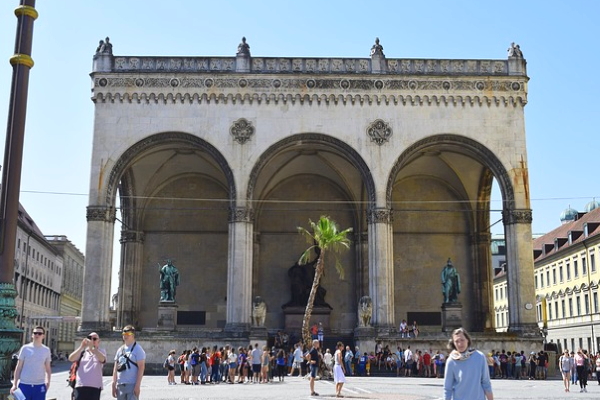 Commander’s Hall Munich
Main Buildings at Odeonsplatz
Theatiner Church
The bright yellow Theatiner Church (Theatinerkirche St. Kajetan) dominates the square. Built in the Italian Baroque style, it stands out because of its Mediterranean appearance.
Inside, you’ll find white stucco decorations and the crypt of the Wittelsbach dynasty.
Feldherrnhalle
The Feldherrnhalle is a loggia modeled after the Loggia dei Lanzi in Florence. It commemorates Bavarian military leaders and became historically significant during the 1923 putsch.
Munich Residence
Right next to the square is the Munich Residence, the former palace of Bavarian rulers. Together, these buildings create one of the most architecturally impressive ensembles in Germany.
Ludwigstraße
From Odeonsplatz, Ludwigstraße stretches northward with grand neoclassical buildings. This boulevard reflects King Ludwig I’s vision of a monumental capital city.
Architectural Style
Odeonsplatz blends several styles:
- Italian Baroque (Theatiner Church)
- Florentine Renaissance inspiration (Feldherrnhalle)
- Neoclassical architecture (Ludwigstraße)
The combination gives the square a southern European atmosphere that contrasts with the Gothic style of the nearby Frauenkirche.
Impressions Odeonsplatz (video, YouTube)
Atmosphere Today
Today, Odeonsplatz is lively but elegant. Street musicians often perform here, and it is a common meeting point for locals and tourists. During major events or demonstrations, the square is occasionally closed to traffic.
In summer, the warm yellow façade of the Theatiner Church looks especially impressive in the afternoon sun.
How Long Should You Plan?
- 15–20 minutes: Walk across and take photos
- 30–60 minutes: Visit Theatiner Church or Feldherrnhalle
- Half day: Combine with Residence and Hofgarten
Best Time to Visit
- Morning for fewer crowds
- Late afternoon for warm lighting
- Evening for a quieter atmosphere
How to Get There
Odeonsplatz has its own U-Bahn station:
- U3, U4, U5, U6 – Odeonsplatz station
It is also within walking distance of Marienplatz.
More travel tips:
Stay Near Odeonsplatz
Accommodation near Odeonsplatz offers immediate access to Munich’s historic center and top landmarks.
Pros and Cons
Pros
- Architectural highlight
- Central location
- Free to visit
- Easy to combine with other attractions
Cons
- Short standalone visit
- Can be crowded in peak season
Is Odeonsplatz Worth Visiting?
Yes. Even if you spend only a short time here, Odeonsplatz is one of the most photogenic and historically significant squares in Munich. It perfectly connects royal history, religious architecture and modern city life.
