 Veröffentlicht von
 The Siegestor (Victory Gate) is one of Munich’s most impressive monuments and a powerful symbol of the city’s history. Located between the districts of Maxvorstadt and Schwabing, the arch marks the northern end of Ludwigstraße and stands as both a triumphal monument and a reminder of war and peace.

While many visitors focus on Marienplatz or the Frauenkirche, the Siegestor offers something different: a monumental structure that reflects 19th-century ambition, World War destruction and postwar reconciliation.
Explore Munich with a Guided Tour
Many walking and bus tours pass the Siegestor and explain its historical background in detail.
Where Is the Siegestor?
The Siegestor stands at the northern end of Ludwigstraße, one of Munich’s grand boulevards. To the south lies Odeonsplatz and the Old Town. To the north begins the lively university and Schwabing district.
Nearby attractions include:
This central location makes the Victory Gate easy to include in any city walk.
What Is the Siegestor?
The Siegestor is a triumphal arch modeled after the Arch of Constantine in Rome. It was commissioned by King Ludwig I of Bavaria and completed in 1852 under his son, King Maximilian II.
The monument was originally dedicated to the Bavarian army and celebrated military victories.
Architecture and Design
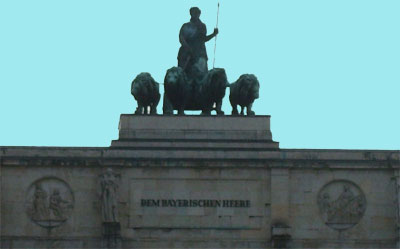
The structure features three large archways and is crowned by a bronze statue of Bavaria riding in a chariot drawn by four lions (a quadriga). The lions symbolize strength and Bavaria’s heraldic emblem.
Architectural highlights include:
- Three symmetrical archways
- Large relief sculptures
- Latin inscriptions
- The bronze Bavaria statue on top
The arch is approximately 24 meters high and dominates the surrounding urban space.
Destruction and Reconstruction
During World War II, the Siegestor was heavily damaged by air raids. Much of the structure was destroyed or severely impacted.
After the war, Munich decided to rebuild the monument — but not as a pure symbol of military triumph. Instead, it was reconstructed as a memorial for peace.
A new inscription was added on the north side:
“Dem Sieg geweiht, vom Krieg zerstört, zum Frieden mahnend.”
Translated:
“Dedicated to victory, destroyed by war, urging peace.”
This inscription fundamentally changed the meaning of the monument.
Symbolism of the Siegestor
The Siegestor represents two different eras:
- 19th-century nationalism and military pride
- Postwar reflection and commitment to peace
This dual symbolism makes it one of Munich’s most historically complex monuments.
Siegestor vs. Other Triumphal Arches
Unlike larger European arches such as the Arc de Triomphe in Paris, the Siegestor is smaller but architecturally similar. It reflects the influence of classical Roman design on 19th-century European architecture.
Compared to Munich’s medieval structures like the Frauenkirche, the Victory Gate belongs clearly to the neoclassical urban development of the Ludwigstraße era.
Best Time to Visit
- Morning: Fewer cars and softer light
- Late afternoon: Warm lighting on the façade
- Evening: Illuminated structure
Since it stands in the middle of a busy street, photography is easiest from sidewalks and pedestrian areas.
Photography Tips
- Stand slightly north toward Schwabing for symmetrical shots
- Use a wide-angle lens to capture the full arch
- Include Ludwigstraße perspective in your composition
- Photograph at dusk when lights turn on
How Long Should You Plan?
The Siegestor itself can be viewed in 10–15 minutes. It is not a museum and cannot be entered. Most visitors stop briefly while walking between the Old Town and Schwabing.
How to Get There
Public transport options:
- U-Bahn: Universität station
- Tram lines along Ludwigstraße
- Walking from Odeonsplatz (approx. 5–10 minutes)
More information:
Pros and Cons
Pros
- Impressive architecture
- Important historical symbolism
- Free to visit
- Central location
Cons
- Located in busy traffic area
- No interior access
- Short visit duration
Is the Siegestor Worth Visiting?
Yes, especially if you are interested in architecture and history. The Siegestor may not take long to explore, but its symbolic message and architectural presence make it an important stop in Munich.
Our tip: Munich city tour |
| A great possibility to see a lot of Munich in 1-2 days are the so called Hop On / Hop off buses. These are red double-decker buses in British style, which drive on 3 different routes through Munich. You can get off at many stops and continue with a later bus. Tickets for the hop on / hop off buses are much cheaper on the Internet at Getyourguide than on site. Further information: Click here |